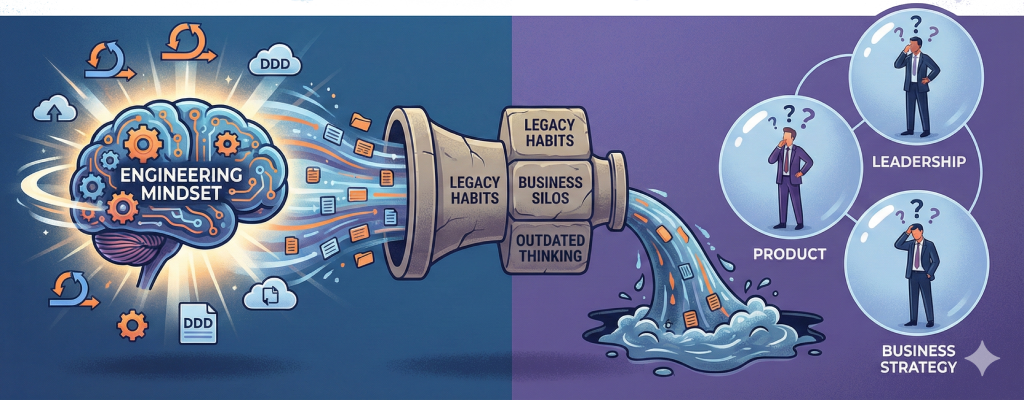
In most tech companies, the biggest bottleneck isn’t technology; it’s people holding on to outdated mindsets and long-established habits.
For years, we have treated every advancement as a purely technical matter, automatically assigning engineering teams the responsibility to learn, adapt, and “make the magic happen.” But today, many of the most critical advancements are not centered around code or tools alone. They reshape how teams collaborate, how decisions are made, and how value is created across the entire organization.
Take Domain-Driven Design, for example. It is not simply a technical practice meant only for engineers. It is an organization-wide discipline that requires shared understanding, a common language, and active involvement from business and product as well. The same applies to many modern approaches such as Agile, Continuous Delivery, the Empowered Team mindset, Team Topologies, OKRs, and more. These are not just engineering practices; they are business survival skills that demand organizational awareness, alignment, and commitment.
Agile, for instance, is not something only engineering teams can adopt. A company is either Agile as a whole — or it is not Agile at all.
This mindset is precisely why so many companies fail to fully benefit from the innovations of the modern software era.
It’s like trying to fly an airplane with only one wing: engineering.
And the result is predictable — sloppy DDD implementations, “Agile sucks” complaints, business-misaligned OKRs, and the recurring Feature Factory anti-pattern.
We are no longer in a world where engineering teams evolve continuously while the rest of the organization remains anchored in old ways of thinking and past experience. Today, product and business leaders are expected to possess at least foundational knowledge of Strategic Domain-Driven Design, Team Topologies, Systems Thinking, Technical Debt as Business Risk, the Empowered Product Team concept, and strategically business-aligned OKRs.
Engineering teams are the first to experience the consequences of this imbalance. They carry the burden of progress while operating within an ecosystem unwilling to challenge its legacy habits. And when they attempt to raise awareness or share modern practices, their efforts are often met with superficial acknowledgment rather than genuine adoption. Over time, motivation erodes, trust weakens, and valuable organizational energy is lost.
If this adoption — and the accompanying shift in mindset — is not actively owned, modeled, and reinforced by senior leadership, these modern practices will never move beyond cosmetic implementations. Deeply rooted habits do not dissolve through good intentions or engineering enthusiasm. They change only when the organization’s power structure makes transformation non-negotiable.
Modern software engineering is not an engineering-only concept.
It is an organizational mindset — and it must be embraced as such.